Mostrando entradas con la etiqueta PRESENTE. Mostrar todas las entradas
Mostrando entradas con la etiqueta PRESENTE. Mostrar todas las entradas
12 mar 2026

3 oct 2024
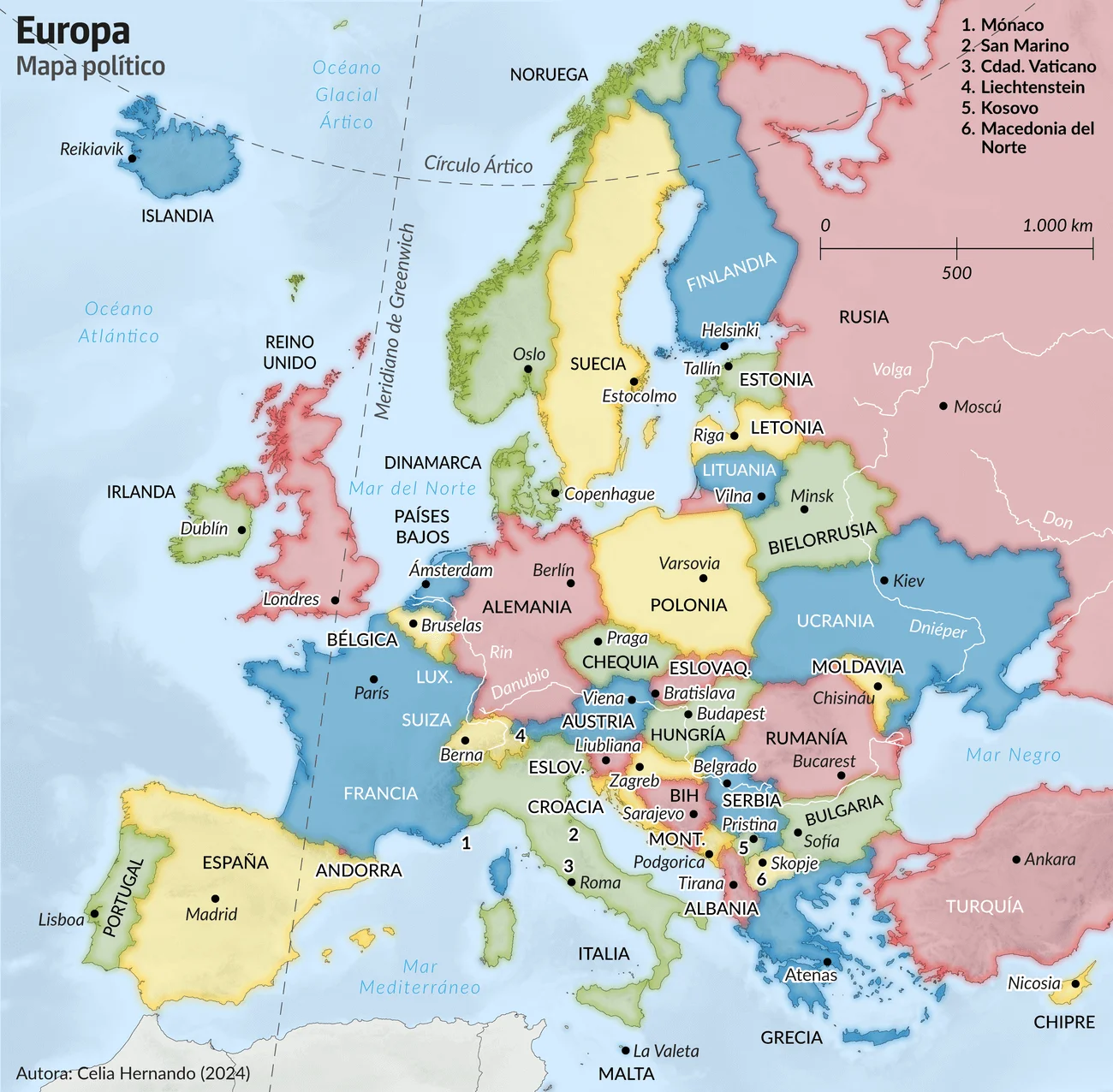
EUROPA LISTADO DE ESTADOS
Albania, Alemania, Andorra, Austria, Bielorrusia, Bosnia y Herzegovina, Bulgaria, Bélgica, Chequia, Chipre, Ciudad del Vaticano, Croacia, Dinamarca, Eslovaquia, Eslovenia, España, Estonia, Finlandia, Francia, Grecia, Hungría, Irlanda, Islandia, Italia, Kosovo, Letonia, Liechtenstein, Lituania, Luxemburgo, Macedonia del Norte, Malta, Moldavia, Montenegro, Mónaco, Noruega, Países Bajos, Polonia, Portugal, Reino Unido, Rumanía, Rusia, San Marino, Serbia, Suecia, Suiza, Ucrania.
Ámsterdam, Andorra la Vieja, Atenas, Belgrado, Berlín, Berna, Bratislava, Bruselas, Bucarest, Budapest, Chisináu, Copenhague, Dublín, Estocolmo, Helsik, La Valeta, Lisboa, Liubliana, Londres, Luxemburgo, Madrid, Minsk, Moscú, Mónaco, Nicosia, Oslo, París, Podgorica, Praga, Pristina, Reikiavik, Riga, Roma, San Marino, Sarajevo, Skopie, Sofía, Tallin, Tirana, Vaduz, Varsovia, Viena, Vilna, Zagreb, Kiev.
DIDACTALIA
30 nov 2021
The new international order

1.1 The new international order
In 1991, the bipolar order marked by the division of the world
into blocs disappeared and a new unipolar order began in which
the __________became the only global superpower.
But since the beginning of the 21st century, and especially
since the __________ crisis of 2008, the world has been moving
towards multipolarity or collective decision-making.
The causes that have driven multipolarity are several:
➜ Opposition to American_____________.
➜ The influence that other traditional powers like _______ and
the European Union maintain and the economic surge of new
emerging groups like the BRICS and TICKS, which are claiming
greater power in global decisions
➜ The importance of the __________ countries.
1.2 The global system of states and their conflicts
In the world today, countries are grouped into large regions of
similar political, economic, social and cultural traits.
These regions are the traditional ______of power –the US,
Japan and the EU; Southeast Asia– where the emerging powers
China and _______stand out; Russia and the republics of central
Asia; the ________Arab world; Latin America; and Sub-Saharan
Africa.
Relations between the global _________are not egalitarian,
as significant differences in power and influence exist between
them. As a result, since the end of the Cold______, international
areas of tension and conflict have multiplied.The main areas of
tension are located in Africa, the Middle East and Southeast Asia.
The most frequent international conflicts today are those where
two or more neighbouring countries are in opposition;
this is the case with India and ______, the two Koreas, and the
Arab countries and Israel. Civil wars, or confrontations between
members of the same society, also abound.
The causes of these conflicts can be quite diverse:
➜________. This group includes territorial conflicts,
that is, over borders or the desire to control territories
considered__________; nationalistic disputes over
certain territories’ desire for autonomy or independence; and
those that are the consequence of political regime changes and
the _______for liberties.
➜ Economic. The most frequent are over control
of resources (water, land, oil) or minerals (diamonds, uranium,
coltan).
➜ Other causes of conflict are______, motivated by
confrontations between racial groups, and religious, if different
religions (Christianity and Islam) or different denominations of the
same religion (Shiites and Sunnis) clash.
BRICS is the acronymcoined to associate five major emerging economies: Brazil, Russia, India, China, and South Africa. The BRICS members are known for their
significant influence on regional affairs.[1] Since 2009, the governments of the BRICS states have met annually at formal summit1. 1 Define: unipolar when did it take?
bipolar, multipolarity order.
2. What causes have driven multipolarity?
3. Guess the countries of emerging countries TICKS
4. Define emerging country and give examples.
5. Where is the areas of main tension?
6. What is cause of the most international frequent conflict? Give an example.
7. Describe the political causes.
8. What is the most economic frequent conflict?
9. Can you describe other cause of conflicts?
https://elpais.com/politica/2016/03/09/actualidad/1457534124_969445.html

12 oct 2021
3 oct 2021
WHAT´S GLOBALISATIÓN ?
https://www.learnpick.in/prime/documents/ppts/details/333/international-organisation

1. What are some unpleasant side effects of globalization?
2. How many people have more money than all the money owned by the poorest half of the entire world's population
3.What movements or organizations have been created because of the problem of inequality?
4.What is the difference between the 1950's and nowadays 21sth century?
5.Older generations blame Globalization, free trade and open immigration policies, what are politicians doing to change negative voters against globalization?
6. Has this made things worse or better? Why?
7-What are some solutions to the problems caused by
globalization, given to us in the video?
1. What are some unpleasant side effects of globalization?
-
Increasing inequality. People lose jobs through
outsourcing and an increase of foreign
migration workers
-
Only the best companies with the best technology thrive/succeed.
2. How many people have more money than all the money owned by
the poorest half of the entire world's population?
-
8
3. What movements or organizations have been created because of
the problem of inequality?
-Occupy Wall Street
-Fighting Inequality Alliance
4. What is the difference between the 1950's and nowadays 21sth
century?
-Inbetween 1950's and 1990's it
was expected that most children make higher incomes than their parents,
nowadays that is not as comun.
5 Older generations blame Globalization, free trade and open
immigration policies, what are politicians doing to change negative voters
against globalization?
-
Turn inwards to help ensure jobs don't leave the
country, they lock down borders, decrease the number of work visas and punish
companies for not using local labor
6. Has this made things worse or better? Why?
-
Worse, because protectionism has been proven(throughout
history) that it leads to slower growth and decreases the competitiveness of
nations engaged in such policies
7 What are some solutions to the problems caused by
globalization, given to us in the video?
-
find ways to address the problem of extreme wealth
inequality and encourage reasonable sharing in the global marketplace. To do
this companies and governments must work together to improve their
competitiveness and make the world more global, not less.
-
this needs to be done in a way that will help
transition and retrain workers who are being displaced, moving them to areas of
growth, like healthcare, information technology, automobiles,energy, farming,
education, financial services
- focus on 3 initiatives:
1. To revive through increased
innovation
2. To improve transitions from
education to employment
3. Adjust taxes raising disposable
incomes for low and middle income households
Suscribirse a:
Entradas (Atom)